
A baby, a corpse, and a deadline
To save a stolen baby, Hellboy has to bury a corpse before sunrise. The dead keep telling him there is no room. That is a very good introduction to the kind of trouble The Corpse has waiting for him.
A mother is certain that the baby in her crib is not hers. The child looks ordinary until Hellboy brings out a horseshoe. Once the deception is exposed, getting her real child back means carrying a talking dead man across the Irish countryside and asking for a place to put him.
There are rules to negotiate and creatures to deal with, but Hellboy is clear about what he is there to do. When asked what he would do to recover the baby, he says he will do whatever it takes.
He can complain and still mean it
That is what I love about Hellboy here. He complains about the smell. He argues with the dead. Then he keeps carrying the corpse. His irritation never makes the person who needs him stop mattering.
Mignola also gives the fairy folk a desperation you can understand. They are dying out and can no longer have children of their own. Taking someone else’s child is cruel, and learning why they did it does not make that cruelty disappear. It gives the encounter a sadness that stays with me.
The story can be funny in one exchange and lonely in the next. Hellboy’s practical determination holds those feelings together. He has a child to bring home, and another graveyard to try.
The hill, the doorway, the dark
Mignola makes Hellboy small against an empty hillside. The figure carrying the corpse has a long stretch of night around him. Then the sequence moves closer: a church, a door, the darkness inside. The shift in scale makes approaching the building feel like a decision.
The strong black shapes leave parts of the world unreadable while keeping the important gesture clear. You can follow the burden on Hellboy’s shoulder or the direction of his attention without having every surface explained. That clarity gives the quiet panels time to work.
It also gives a face enormous force when Mignola brings us near one. In The Wolves of Saint August, a little girl’s glowing, empty eyes are immediately frightening. What she says next asks us to look at her differently.
Kate hears a child who needs comforting
Hellboy and Kate Corrigan arrive in a village where everyone was killed in one night. When Kate meets the little girl, the child says that she cannot sleep and cannot go to heaven. She believes that God hates her.
Kate answers with reassurance. The girl looks like part of the nightmare, and Kate hears someone who needs comforting. That instinct to care connects this story to Hellboy carrying the corpse through the countryside.
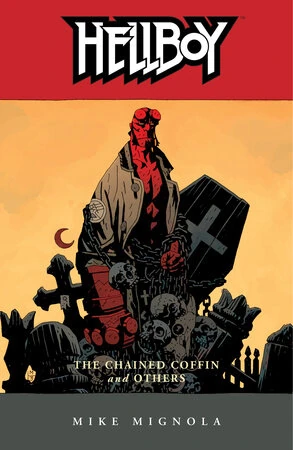
Both stories are in The Chained Coffin and Others. This review focuses on those two encounters, rather than covering every story in the collection. What keeps bringing me back is how the horror fails to make these people stop caring. What stays with you longer: what frightened you, or what made you care?