
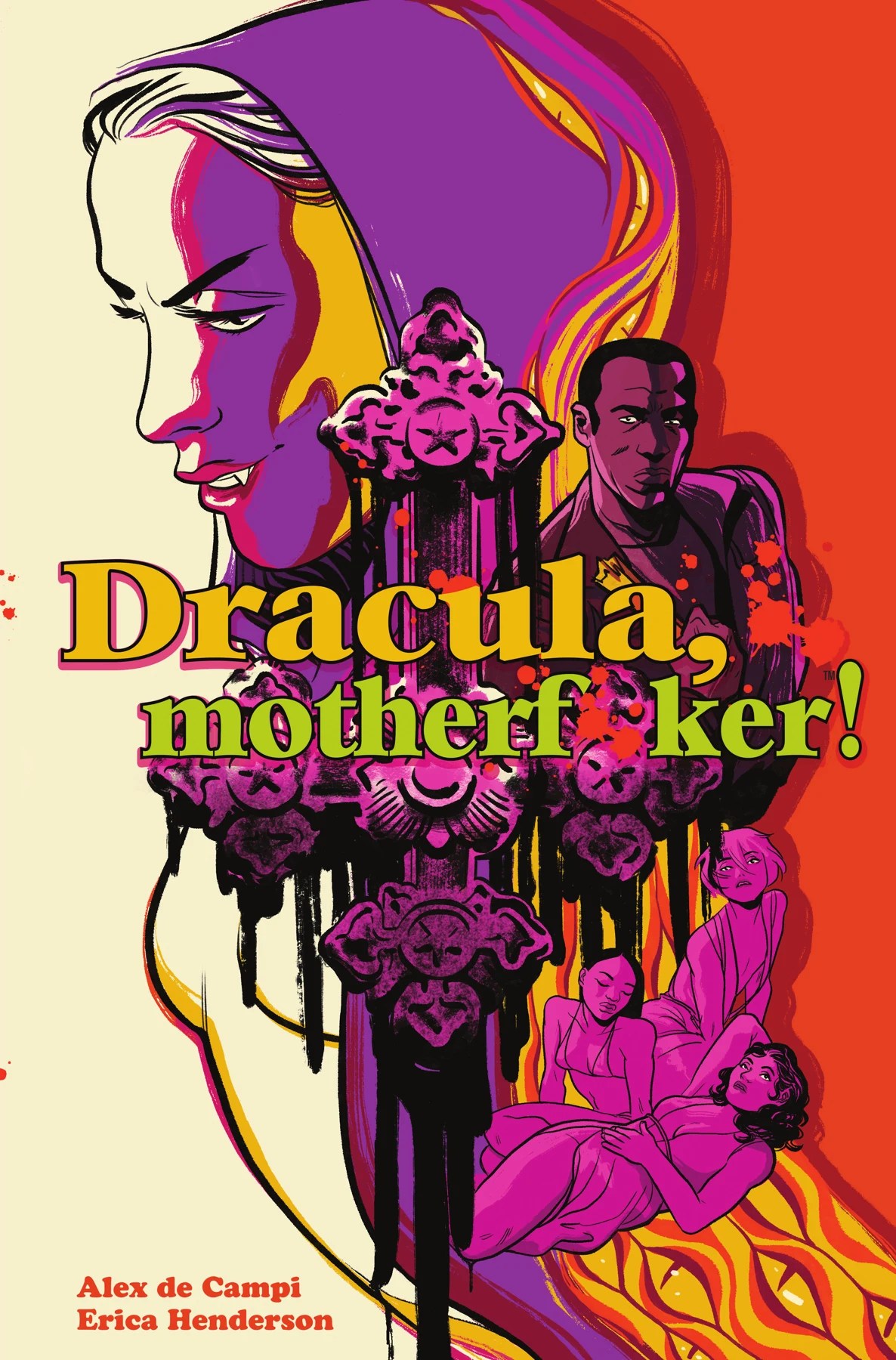
Dracula, Motherf**ker! cover

Horror · Spoiler-light review

Dracula, Motherf**ker!: Hollywood Let the Monster Out

The noir drew me in. Erica Henderson’s swarm of eyes, teeth, and extraordinary color made this vampire story impossible to look away from.

The book

Dracula’s brides nail him inside his coffin in Vienna in 1889. Eighty-five years later, a fading movie star in Los Angeles releases him, and crime-scene photographer Quincy Harker finds himself caught in what follows.

Alex de Campi · Erica Henderson

The verdict

A short, fast horror graphic novel with a noir entry point and artwork worth slowing down for. The pleasure is in the atmosphere, the color, and seeing how far Henderson can push a monster who was never meant to be charming.

Read it if

You want a complete vampire story, a 1970s Los Angeles setting, bold color, and page design that makes the darkness feel alive.

Maybe skip if

You want a romantic Dracula, a long investigative puzzle, or a lengthy character saga. This is a compact, visually driven horror story with graphic violence.

Content note

Blood, graphic violence, disturbing monster imagery, predatory relationships, and abusive power. This review discusses the setup and visual approach without revealing the ending.

The women who put him away

His own brides nailed Dracula into his coffin. That is where this story begins: Vienna, 1889, with three women who have had enough of the monster they married. The opening gives them an intention of their own before we follow anyone into Los Angeles.

The opening gives Dracula’s brides a shared purpose: putting the monster away.Dracula, Motherf**ker! · Alex de Campi, writing and lettering; Erica Henderson, art and colors. Artwork © its respective rights holders. Book and creator details.

By 1974, a fading movie star wants what Dracula can offer. Hollywood is a fitting place for a creature promising youth and beauty. The people who let him in do not need him to look harmless; they need to believe the bargain will be worth it.

A man already living off the dead

I was hooked when Quincy Harker picked up his camera. He is a crime-scene photographer, making his living from the dead before a vampire enters the picture. That connection gives the noir setting more than a familiar look. Quincy is used to arriving after something terrible has happened. Now he is caught in something that is still happening.

Quincy’s work supplies the noir entry point; Henderson makes the night feel charged with danger.Dracula, Motherf**ker! · Alex de Campi, writing and lettering; Erica Henderson, art and colors. Artwork © its respective rights holders. Book and creator details.

The camera gives us a way into this world: bodies, nighttime streets, a photograph someone wants to put on the front page. But make no mistake, this is horror. The women who put Dracula away have plans of their own, and Quincy is not simply investigating a case from a safe distance.

Eyes in the black, color all around them

What I most wanted to show people is what Henderson does with Dracula. Eyes stare out of the black. Teeth fill a mouth. Sometimes you can barely tell where his body begins. He spreads through the darkness around the people he threatens, and another eye appears where you thought there was only shadow.

Dracula is difficult to separate from the darkness around his victim.Dracula, Motherf**ker! · Alex de Campi, writing and lettering; Erica Henderson, art and colors. Artwork © its respective rights holders. Book and creator details.

Henderson gives that darkness extraordinary color to swallow: acid greens, deep blues, hot pinks, and reds. A phone booth glows. A car interior feels enclosed by color. A doorway opens onto a room that looks as though it is already burning. The city feels seductive and dangerous before a vampire even appears.

The color also helps you navigate. Each setting has its own visual identity, so you feel the change of scene before you have read a word. In her back matter, Henderson discusses planning the layouts as spreads and adding color during that process. You can feel that attention to the whole opening: shapes, colors, and stretches of black carry your eye beyond an individual panel.

Strong color relationships help the reader move between figures, panels, and settings.Dracula, Motherf**ker! · Alex de Campi, writing and lettering; Erica Henderson, art and colors. Artwork © its respective rights holders. Book and creator details.

What the bargain costs

In her afterword, de Campi argues for a Dracula who is not handsome. It makes the promises around him more uncomfortable. What would someone accept for the life they have been offered? What would it take to decide that the price is too high?

That bargain is what interests me underneath the spectacle. The brides have a reason to be here beyond looking beautiful beside him. Their relationship to his power gives the monster something to expose about the people around him.

This is one complete graphic novel, and a quick read. I would choose it for the atmosphere, the color, and the imagination in the drawing, then give those spreads another look. Do you like your vampires charming, or completely monstrous?
Find your next comic

Follow what you liked.

Ground Floor Comics matches you with comics by what you actually liked about a book. Each shelf follows a different part of its appeal.

Explore horror comics

Shelves from Dracula, Motherf**ker!

We’re still reviewing this book’s shelf connections. Try the recommendations above while we build its coverage.

Watch the video review

Comics for Halloween · Part 19

Narrated by Josh Brown with on-screen captions.

2:36 · Narrated by Josh Brown

Artwork belongs to its respective creators and rights holders.

Follow Ground Floor Comics for more short reviews.

Open watch page and more videos →

Back to what to read next
The Low, Low Woods cover

Comics for Halloween · Part 20

The Low, Low Woods

Carmen Maria Machado · Dani · Tamra Bonvillain · Steve Wands

Missing hours divide two best friends in a town that looks beautiful, feels unhealthy, and has learned to live with terrible things.

Read Part 20 →